

Specific restrictions are in place for various customer types, including agricultural water users. For the full list of regulations and restrictions, see the Greater Vernon Water Use and Regulation Bylaw.
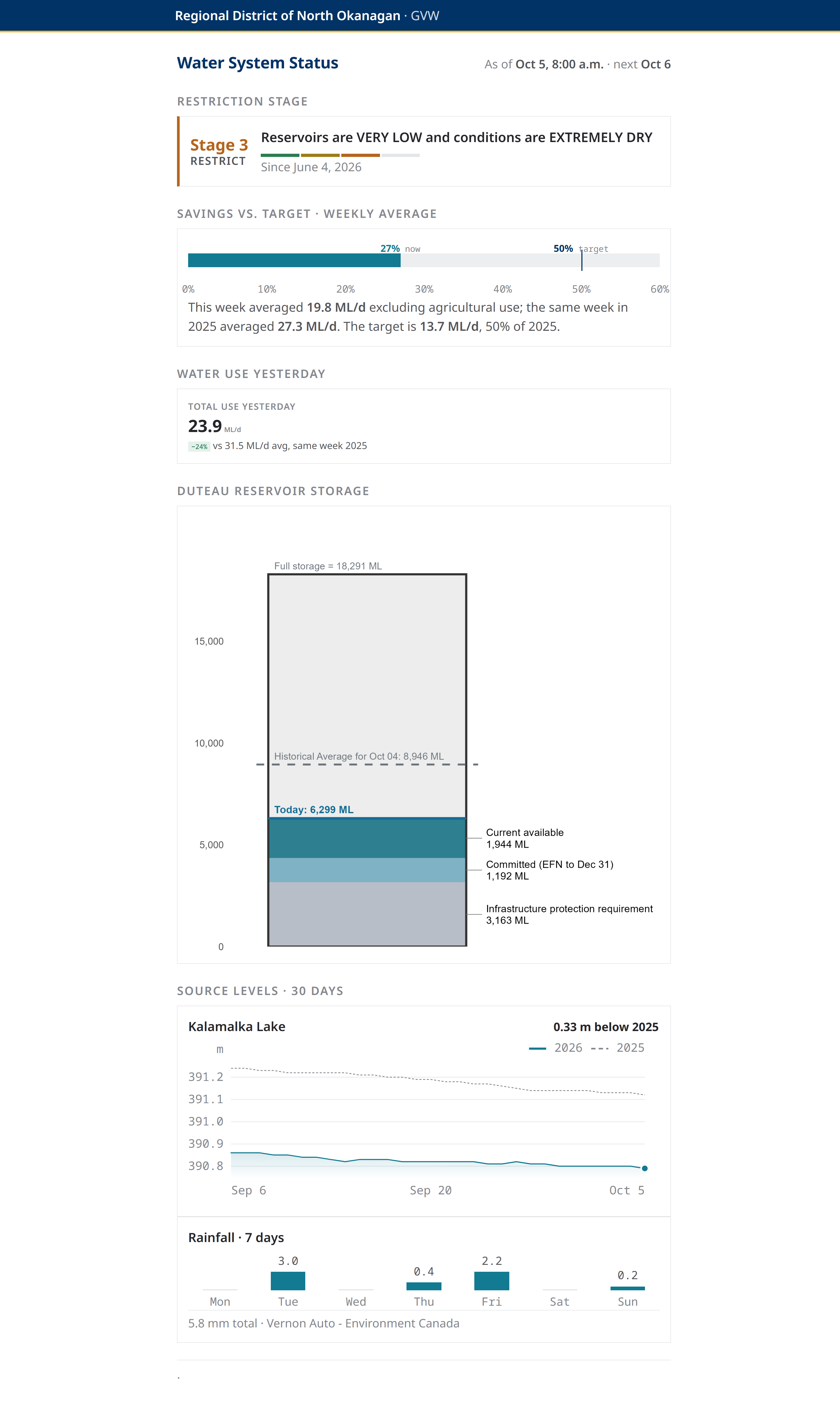
View our monthly water supply update and supply graphs
Visit the Water Conservation page for more tips on waterwise gardening and indoor water efficiency. Customers should note that a higher level of restrictions may be instituted due to drought or emergency. Details relating specifically to Greater Vernon Water's demand management programs can be found below.
Frequently Asked Questions about Stage 3 Water Restrictions
If you are a resident, business, or agricultural water user within the City of Vernon or District of Coldstream, then yes, this applies to you. If you are a resident of Electoral Area B or C, Township of Spallumcheen, or Electoral Area D and are serviced by Greater Vernon Water (GVW), then these restrictions also apply to you.
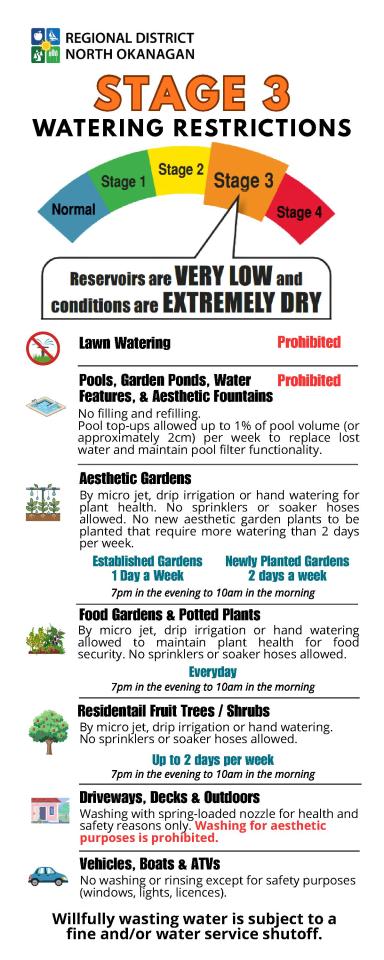
Watering is allowed up to 7 days a week between 7:00pm and 10:00am to maintain plant health for food security. Watering can be done by micro jet, drip irrigation, or hand watering. Sprinklers and soaker hoses are not allowed
Watering is allowed up to 2 days per week between 7:00pm and 10:00am by micro jet, drip irrigation or hand watering for plant health. Sprinklers and soaker hoses are not allowed.
Watering is allowed by micro jet, drip irrigation or hand watering to maintain plant health. Sprinklers and soaker hoses are not allowed. No new aesthetic garden plants to be planted if they require watering more than 2 days per week.
- Established Gardens May be watered 1 day a week between 7:00pm and 10:00am
- Newly Planted Gardens May be watered up to 2 days a week between 7:00pm and 10:00am
No, filling and refilling with water supplied by GVW is prohibited.
Filling of pools is prohibited. Topping up a pool is allowed up to 1% of pool volume (or approximately 2cm) per week to replace lost water and maintain pool filter functionality.
Even when lawns go brown, they are only dormant and will come back when conditions improve. Allowing your lawn to go dormant forces the plant to grow deeper roots and makes your lawn more resilient.
Water reduction can be achieved by reducing outdoor water use through turning off irrigation and allowing the lawn to go dormant as it will recover during wet seasons. Additionally fixing leaks & running full loads in dishwashers and laundry machines can help reduce water use indoors.
There are lots of ways to save water!
- Take shorter showers (3- 5 minutes) and turn off the water while soaping and shampooing
- Catch shower warm-up water in a bucket and use it for cleaning or for plants
- Reuse cooking water (once cooled) for plants
- Wash fruit and veggies in a bowl and not under running water, then use that water for plants.
- Skip rinsing dishes and scrape them before putting them in the dishwasher
- Only run dishwashers once full
- Fix leaks immediately – even a small leak can waste multiple litres a day.
For even more ideas head to rdno.ca/conservation.
Yes, agricultural properties will be required to reduce their water use by 70%. Without drastic reductions, agricultural customers could potentially be shut off later this summer if the water supply runs out. Greater Vernon Water will be working directly with the agricultural community on how to use the current water supply as efficiently as possible.
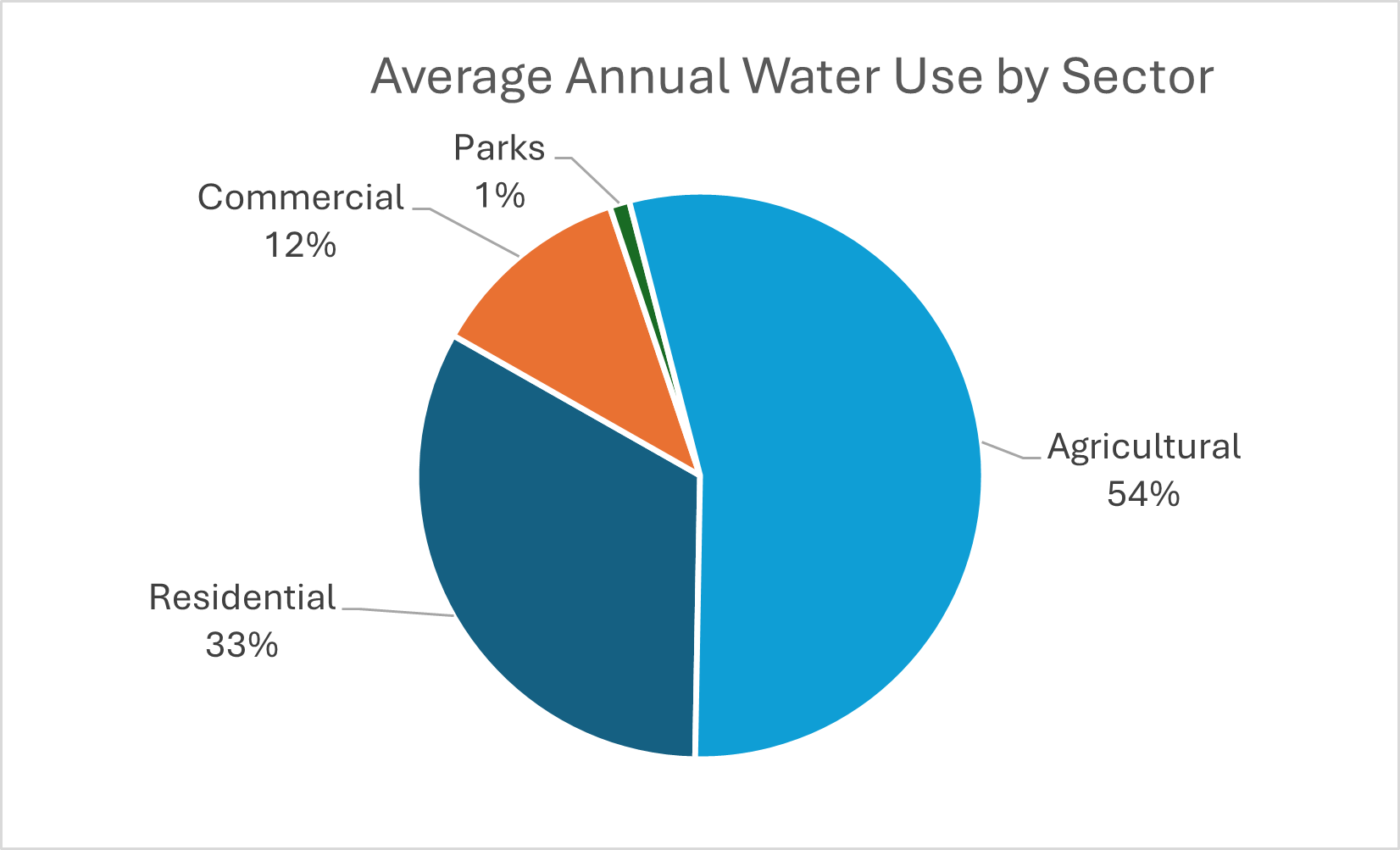
Water supply must be carefully managed to ensure there is enough for essential needs throughout the entire season. Agricultural irrigation uses over 55% of all water used in GVW, with most used over the dry summer months. Without conservation efforts by the agricultural users, the water supply would not last the summer. Reductions help balance agricultural demand with available supply and protect long-term water reliability for all users.
If your property is connected to the GVW system, the restrictions apply. Private wells not connected to GVW are not regulated under these restrictions, but conservation is strongly encouraged.
Yes. All businesses must comply with watering restrictions and are encouraged to implement water-saving practices where possible.
Golf Courses in Vernon are connected to the Vernon Water Reclamation Center’s Spray Irrigation Program, which utilizes reclaimed water. This water is not supplied by Greater Vernon Water and does not impact the regional drinking water supply.
Please send us an email at utilities@rdno.ca with an address and description or fill out a Bylaw Complaint Form at https://www.rdno.ca/form/bylaw-complaint-form-duplicate, and one of our staff members will follow up.
These restrictions are necessary due to low snowpack levels, which have reduced the available stored water, combined with warmer-than-normal spring temperatures and low rainfall for the area. Under the GVW Water Shortage Management Plan, stronger restrictions are required now to protect the water supply throughout summer and fall.
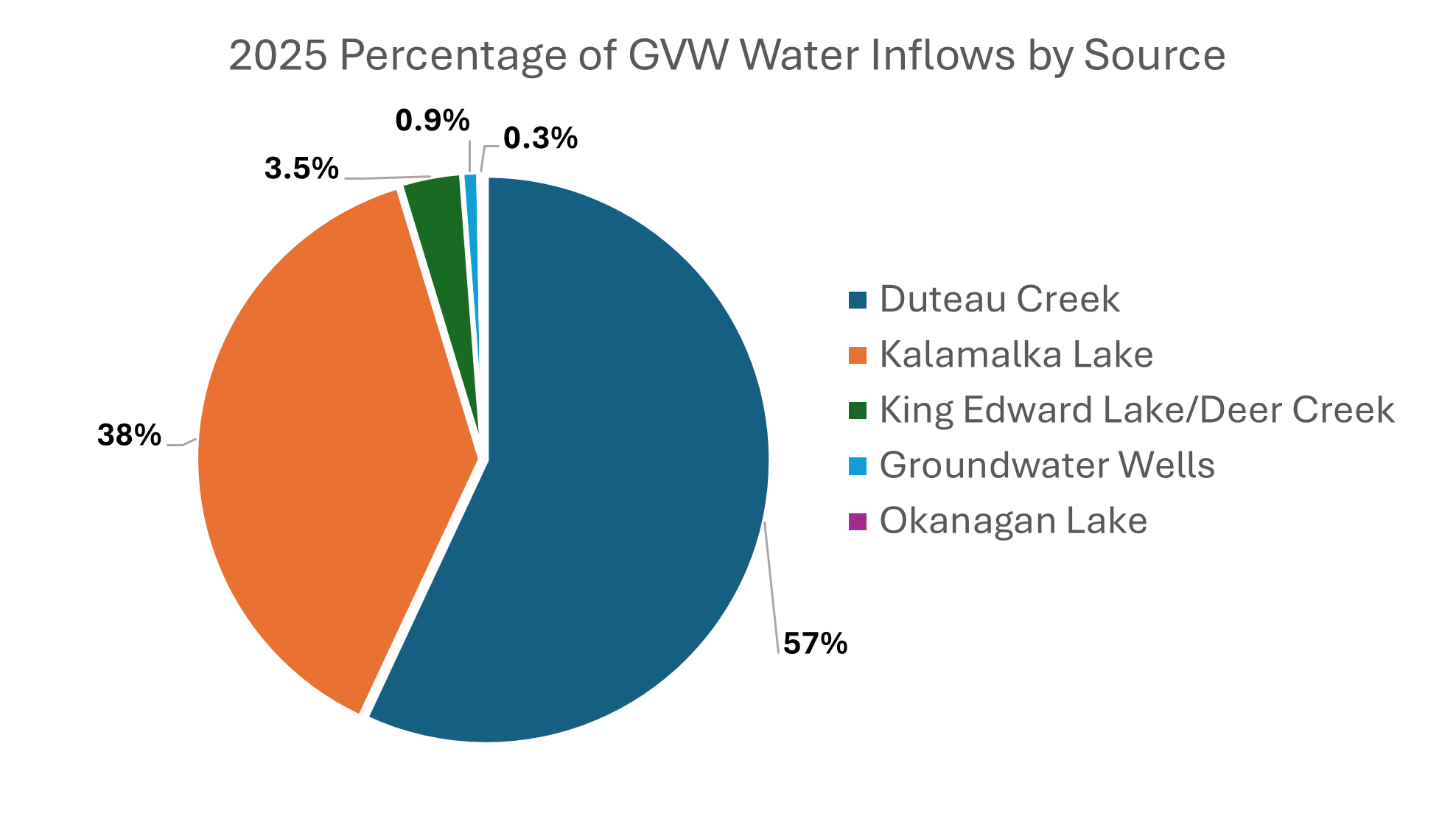
Much of Greater Vernon’s water supply comes from snowpack that melts and fills reservoirs and lakes like Duteau and Kalamalka Lake. Low snowpack means less stored water available for the year. Low storage levels are also aggravated due to the low amount of rain we have received last fall and this spring.
Yes. Water restrictions in Stage 3 are actively enforced. Non-compliance will result in warnings, fines, or further action, including water shut off for continued non-compliance. The goal is to ensure fair and consistent water use across all users and ensure we have water throughout the dry summer season.
If water levels continue to decline, stricter restrictions (Stage 4) may be implemented, which could eliminate outdoor water use and introduce mandatory bans in certain sectors.
Updates will be posted on the RDNO website and shared through local communication channels. Residents and users are encouraged to regularly check for updates as conditions can change throughout the season. Go to our website and subscribe for updates at https://www.rdno.ca/subscribe.
Routine water main flushing has been paused; however, some flushing is still required for essential health and safety purposes to maintain water quality.
We have been in contact with the organizers of this event, and other events in the community. They are required to cut water consumption for the event down by 50% in order to run the event.
Restrictions are based on a combination of factors, not just current lake levels. These include:
- Snowpack levels and how quickly they melted
- Weather forecasts (heat and drought conditions)
- System demand trends
- Treatment and delivery capacity
Acting early helps prevent more severe restrictions later in the season.
Even with infrastructure upgrades, our water supply isn’t unlimited. Over the past several years, we’ve experienced ongoing drought conditions, which means reservoirs and natural water sources are not always fully replenished. Building larger systems does not guarantee more available water.
The Antwerp aquifers contain high amounts of manganese. When chlorinated, manganese will precipitate out of the water and form brown or black particles in the water, which may lead to staining of fixtures and laundry. Water from the Antwerp Deep Well is typically above the aesthetic guideline of 0.02 mg/L, but below the health guideline of 0.12 mg/L. All manganese results were reviewed and approved by the Interior Health Authority before putting the Antwerp Deep Well online. Greater Vernon Water will continue to monitor the manganese levels in the distribution system while the Antwerp Deep Well is being used.
- Image
- Image
Did you know?
Watering during the day can lead to significant water loss due to evaporation, meaning less water reaches your plants' roots where it's needed most. To maximize the effectiveness of your watering, aim to water during the coolest parts of the day. The ideal time to water your plants is between 10 PM and 6 AM. This ensures that more water penetrates the soil and reaches the roots.
Most lawns only need to be watered once or twice a week. Dormancy is a normal part of the grass growth cycle in hot weather. The heat may cause lawns to brown but they will bounce back to their vibrant green in cooler weather.
Reservoir levels are one factor in determining a restriction stage (drought), along with weather forecasts and customer demand levels.
Water use restrictions help minimize water demand spikes – helping to protect our infrastructure from wear and avoiding the cost of building bigger pipes/reservoirs – which is why they are in place year-round. If we enter a drought, more restrictions may be implemented.
Following the restrictions schedule will help you water efficiently and avoid water waste. Your plants will also become better adapted to our normally dry climate.
Efficient irrigation helps keep costs down and saves water for times of drought. Visit the Irrigation Association of BC (IIABC) website for access to their irrigation resources and searchable list of certified irrigation professionals. Farmwest.com has useful information including weather forecasts, manure spreading advisories, Pest Degree Days tool, and irrigation guides. This site also hosts the Agriculture Irrigation Scheduling Calculator, which creates custom irrigation schedules using real-time weather forecasts.
The BC Ministry of Agriculture website has many resources on irrigation, nutrient management and drainage. Several fact sheets are available including:
- 2024 Quick Guide to Drought Resources
- Irrigation Conservation Tips For Farms
- Irrigation Management Guide - BC Ministry of Agriculture
- Irrigation Scheduling
- Drought Management for Farms
Provincial Ministry of Agriculture AgriService – free service to respond to agricultural questions on irrigation and other farm activities:
Telephone: 1 888 221-7141


